
Charlotte Shields-Rossi & Rebecca Jozwiak & Josh Imhof | a&e editor & multimedia & features editor
Last weekend, Jason Wylie planned to spend 24 consecutive hours on an exercise bike.
An Iraq and Afghanistan veteran and ultra-marathon runner, Wylie is no stranger to a challenge, especially when it means supporting fellow veterans.
“I’m sure I’m going to get tired, but at the end of the day, it’s for the veterans, and it’s for my brothers and sisters in arms. They’re tired too, so a little bit of exhaustion doesn’t bother me,” Wylie said.
Over the weekend, he and dozens of others participated in the annual Ruff Ride 24-hour spin relay at the UPMC Cooper Fieldhouse. The event is put on by Team Foster, a nonprofit veterans charity, to raise money to provide service dogs to injured and disabled veterans. This year is the first time the event was hosted at Duquesne University.
Nick Liermann, founder and executive director of Team Foster, created the organization in 2013 in honor of his friend Eric Foster who was killed in Iraq in 2006.
“Eric was a really big influence on me, especially when it came time to learn how to push myself and learn how to take care of other people,” Liermann said.
Since then, Team Foster has had numerous events and ways for volunteers to donate their time, including other cycling challenges and a golf tournament. They also host smaller community events throughout the year to fundraise the mission.
At the fieldhouse, 15 teams duked it out to see who could bike the furthest in 24-hours.
0 hours in
Teams began pouring into UPMC Cooper Fieldhouse on Saturday morning and were greeted by upbeat music that shook the arena.
Steve Mollock, founder of Our Brother’s Keeper, an organization that raises awareness about veteran suicide rates, was accompanied by his friends, wife and children. The group brought chairs, water and snacks and planned to stay the full 24 hours.
Mollock said supporting veterans’ mental and physical health is a cause dear to his heart, especially with how high suicide rates are among them.
“One a day is too many, 22 a day is a tragedy,” he said.
Through his work, Mollock has realized the importance of service dogs and how they can be supportive to those in need.
“It’s a great way to donate our time and efforts,” Mollock said.
Once the clock hit 10 a.m. competitors eagerly hopped on their bikes. The relay was on.

11 Hours in
By 9 p.m. some of the riders who had been there since the start said they were feeling the effects. Some changed out of their sweat-drenched shirts. The smell of body odor hung over the arena.
Wylie, the ultra-marathon runner, was almost halfway through his 24 hours of cycling. Despite acquiring asthma and lung disease during his time in the Middle East, he still intended to do the entire relay himself.
Mollock and his family were also going strong, and he was preparing for his third half-hour session on the bike.
“It’s nothing bad. You overcome personal struggles, you have a little bit of pain, but as long as you can get through it … it’s for a good cause,” he said.
15 hours in
After 15 hours of cycling, Wylie had just crossed the 200 mile mark.
He had only gotten off the bike to take bathroom breaks, and the physical toll was setting in.
“I’m in places I’ve never been before,” he said.
During his time as an ultra-marathoner, Wylie said he and his fellow runners would describe this as the “Pain Cave.” Now, he described it as “Hell’s Hallway.”
Sweat stained his grey shirt and slicked the floor around him, but he said he was not going to stop. A photo of Kurt Krout , his friend who passed away in Iraq, sat on the handlebars of his bike.
“It’s not about me,” Wylie said.
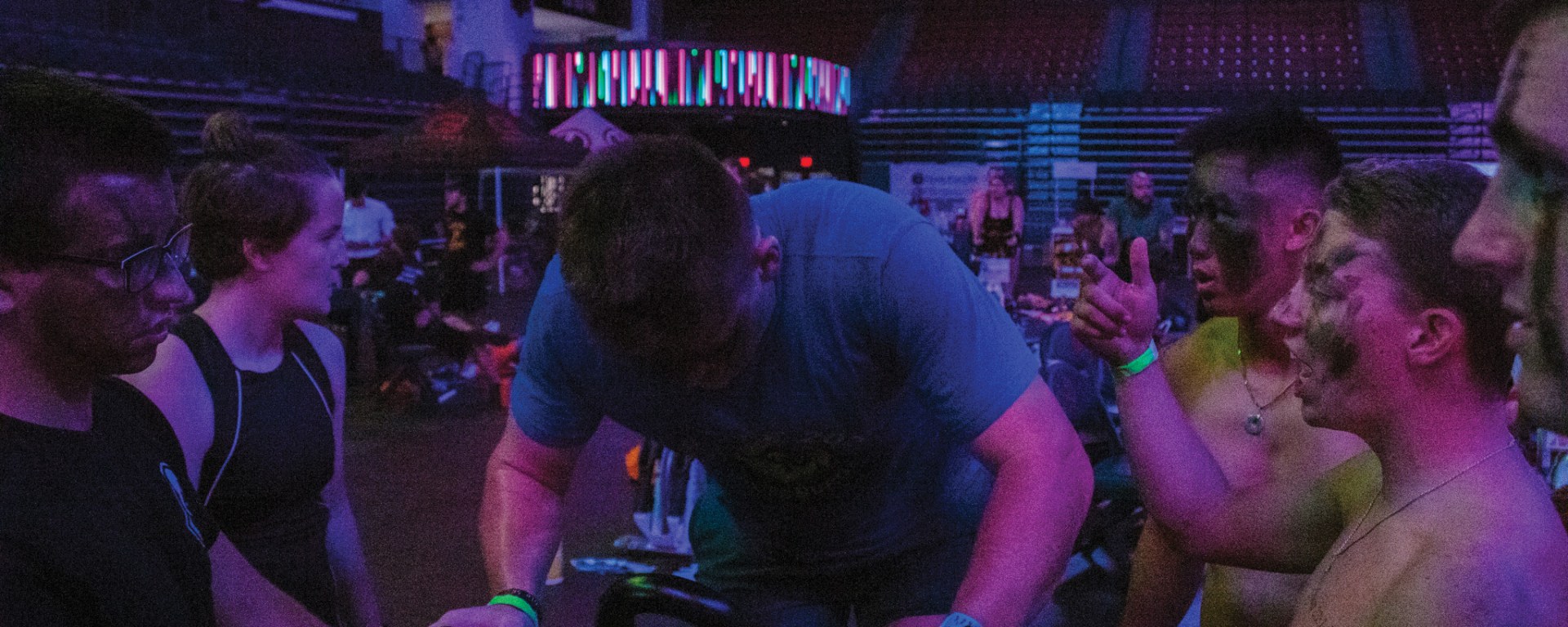
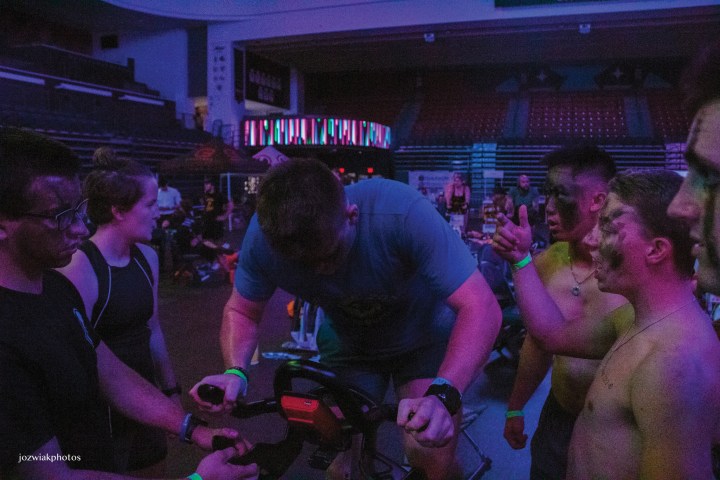
A few bikes over from Wylie were members of the Pittsburgh NROTC. These future U.S. Navy men and women were doing “sprints” and rotated positions every few minutes. Two would unhook the pedal straps while the others emphatically cheered them on.
“The more we push together, the stronger we are,” said Brian Shimp.
Members of other teams in the arena walked around with their hands interlocked on the backs of their heads, while some slept on the floor with towels over their faces.
17 hours in
Liermann hopped on a bike, pledging $250 dollars of his own money that no one could beat him in a race.
“Its the hardest, darkest, most unusual time that I would do something really hard and that’s something that Eric would have really been into. It’s a great way to get people pumped up at what is otherwise a pretty tough hour,” Liermann said.
Liermann lost and ended up donating the money.
The finish line
The UPMC Cooper Fieldhouse was more crowded than it had been for the entire event. Teammates circled around bikes as their fellow cyclists completed the home stretch of the relay. Spin instructors, who had helped lead the event, ran through the crowd to rally the riders.
Steve Mollock’s young son hopped on the bike and rode the last 10 minutes, while members from other teams swarmed around him to cheer him on, a touching and impactful moment for Mollock.
“He accepted the challenge, everyone cheered him on. It was just great,” Mollock said.
Josh Platts of Team Platts and Company was sitting eyes closed in a lounge chair and listening to music. He had been there for most of the day, but he did not plan on leaving.
“If you think about what these marines go through on a daily basis… it’s only 24 hours,” he said.
Charlotte Shields-Rossi can be reached at shieldsrossic@duq.edu
Rebecca Jozwiak can be reached at jozwiakr@duq.edu
Josh Imhof can be reached at imhofj@duq.edu
 -
- -
- -
- -
- -
-