Josh Imhof | staff writer
1925-1970s
Before keyboards and computers, the newsroom relied on Underwood-brand manual typewriters made in the 1920s and 1930s to crank out articles each week. Functions like deleting words and formatting performed with the click of a button today took much more time to do back then.
“It was really hard to type a story out on those. They were really bad,” said Susan Parker, former editor-in-chief of The Duke from 1975-76.
After the writers finished their stories, they were then sent over to the copy-editing table where editors made final revisions and changes. This was a tedious process since even the smallest edits, such as a missing letter, would require a section of the article to be retyped.
Next, the proof-read articles and headline specifications would be sent out to a printing company to be formatted and printed in the sizes the staff needed.
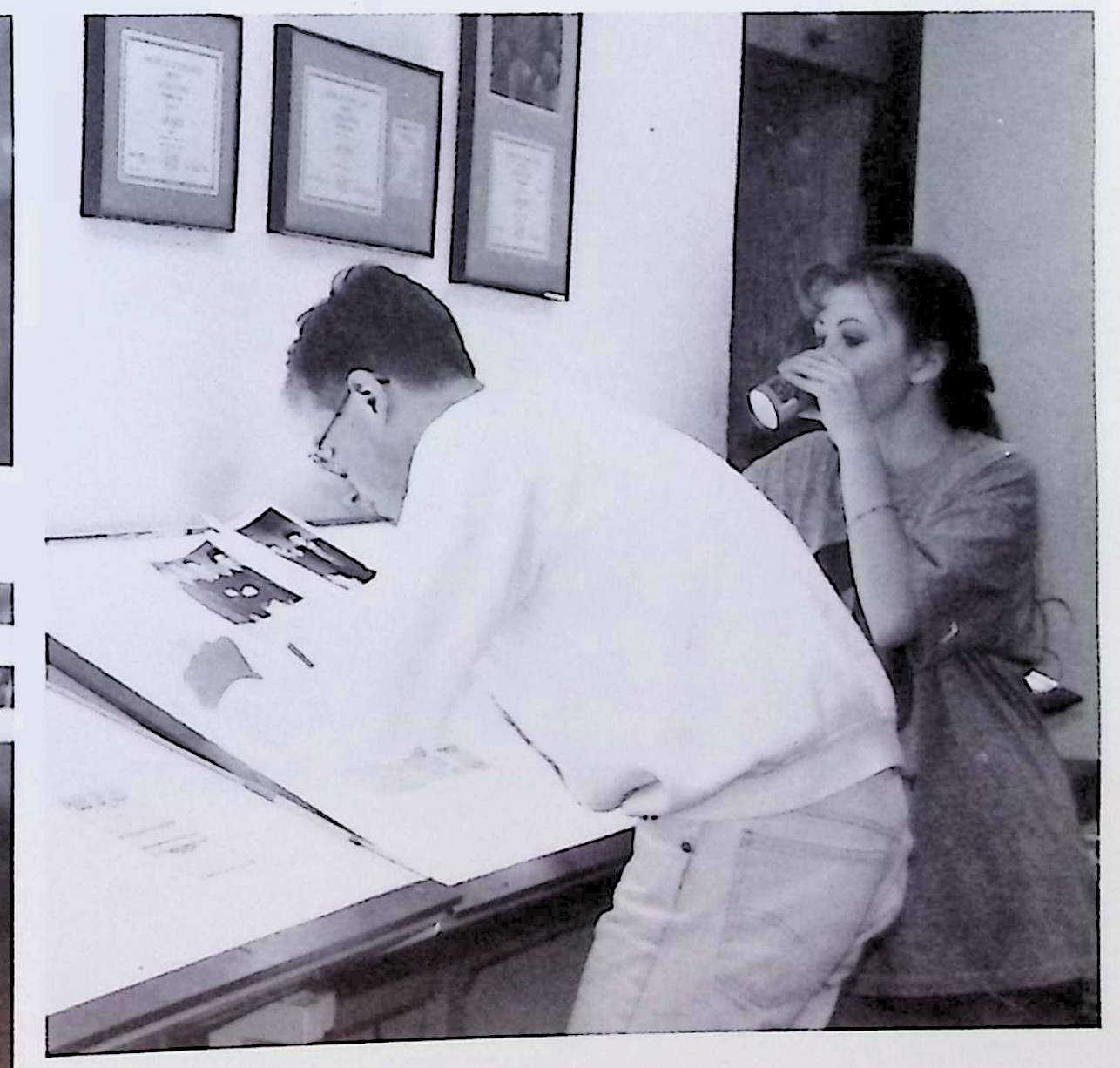
The printer then sent the freshly printed columns and headlines back to be assembled into the final newspaper in a process called the “paste-up”. Each headline, column, photograph and advertisement was meticulously cut with an X-Acto knife and placed onto a layout sheet of wax paper to be arranged in the way the final paper would be printed.
These layout sheets sat on top of large, backlit plexiglass tables that allowed assemblers to see any adjustments they needed to make. The process usually took around three days to complete.
Prior to the 1974-1975 academic year, the printing company would do the paste-up for The Duke. However, budget cuts forced staff to have to learn to do it themselves. To prepare for the start of her tenure, Parker spent evenings after summer classes in the newsroom.
“I had to teach myself the cosmetics of the paper, so I could teach my staff how to do that. They were green about that too,” she said. “It wasn’t as difficult as I thought it would be.”
1980s
The Duke took its first steps into modernity with the integration of Visual Display Terminals, or VDTs for short.
These large and blocky systems required users to type stories into a green-screened computer terminal reminiscent of the 1983 movie “War Games.” Writers would then have to code their own fonts and page specifications into the program, taking crucial time away from actual news coverage.
After this step, reporters would save their data to a cartridge and then transfer it over to a photo processor for the column to be printed onto photo paper. Staff members would use harsh chemicals to get the words to appear on the paper.
“It was kind of sulfurous, like sulfur and vinegar combined. It was not a pleasant smell,” said Dennis Callaghan, the 1989-1990 editor-in-chief of The Duke.
Once the images were printed, editors brought them to the composition room for paste-up.
Early 1990s
At the turn of the decade, The Duke underwent another technological revamp with the addition of desktop computers featuring word-processing softwares. These programs allowed users to pick fonts and format their documents without coding.
This switch also increased the number of machines from two VDTs to six to eight new desktop terminals, allowing more writers to work at once. Laser printers also appeared during this time, freeing staff from having to use any more of the vinegar-scented agents they had dealt with in the past.
Despite the benefits, this process did not come without its growing pains.
“I had never used a Windows PC in my life, so that was all brand new to me. If you look at our very first issues, the headlines are too small for the columns because we didn’t know what we were doing,” Callaghan said. “Nowadays, you take it for granted.”
Writers also had to contend with rudimentary and sometimes unreliable technologies. Sometimes, the fabled “Blue Screen of Death” would appear and a writer’s computer would crash, causing them to lose all of their progress.
Mid-Late 1990s
By the end of the decade, the paste-up was on its way out and pagination was on its way in.
Pagination is the digital assembly and formatting of a newspaper. The process is now the industry’s standard. At the time, this development was revolutionary since it made the process much quicker. Editors would no longer have to spend long hours in the composition room and could instead spend more time reporting and editing stories.
“It was just a whole new world of trying to do pagination from the get go, but somehow we did it,” said Shelley Veltri, editor-in-chief from 1994-1995.
Veltri oversaw the introduction of the new process at The Duke and helped pave the way for editors to continue using it in the future.
This era also saw the introduction of the first digital cameras, however, photographers still largely preferred to use film due to image quality issues and slow download times. It wasn’t until the early 2000s when dependable digital cameras became the standard for photography.
2000s-Present
After a century of evolution, The Duke has now gone digital. All layout editing is now done completely online using computers in the newsroom, making the paste-up process obsolete. Articles are shared virtually with editors, and some reporters will even write complete stories on their phones in order to make deadlines.
 -
 -
 -
 -
 -